
Urban Maroons: Past, Present, and Future
Watercolor with acrylic border
Michaela A. Machicote, December 2024
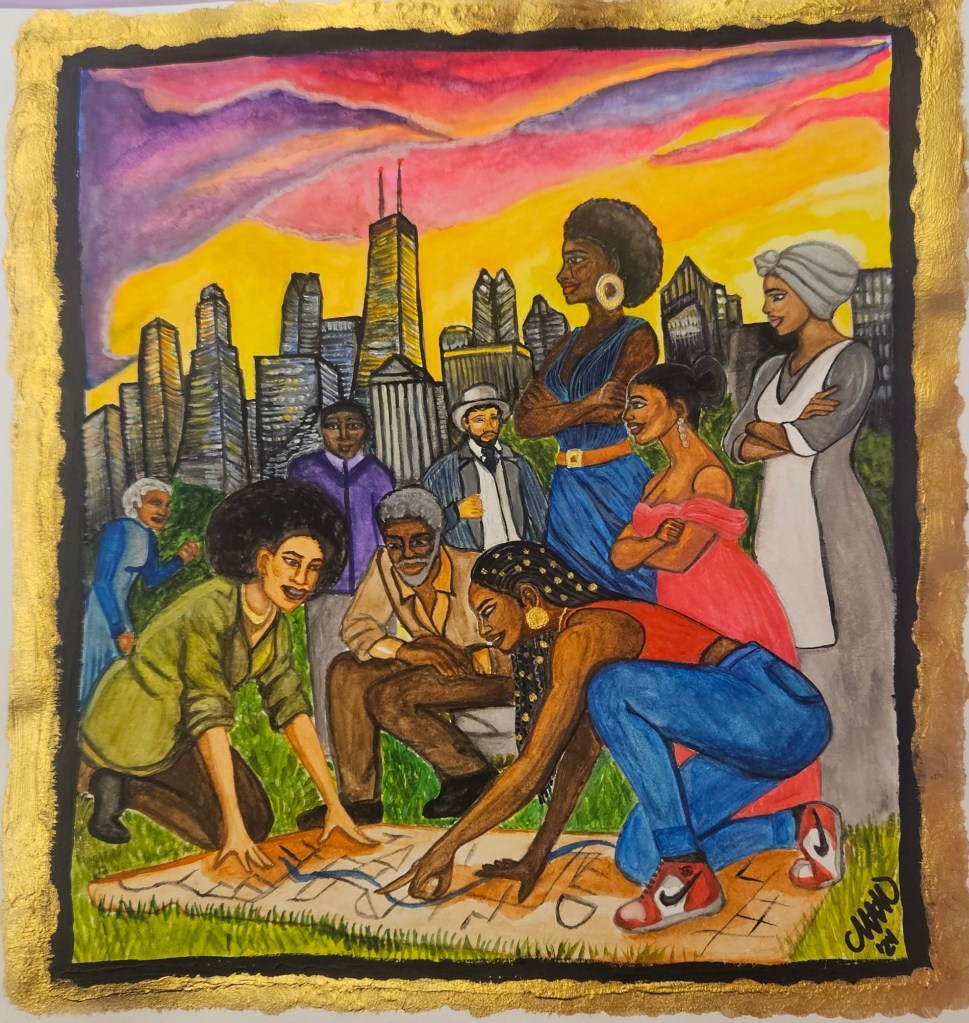
Under a brilliant sky washed in dazzling shades of purple, red, yellow, orange, and pink, Black women and men gather in a grassy field. Two women crouch over a map spread on the ground, as others look on—eager, determined. The Chicago skyline looms in the background, watching over this collective of rebels as they chart their journey toward freedom. Each figure varies in age, occupation, and dress, as if drawn from different time periods and walks of life. Their presence suggests a continuum—past, present, and future—of fugitivity, strategy, and survival.
Scholarship on the ongoing struggle for liberation in the United States has insufficiently explored the links between marronage—defined by Neil Roberts (2015) as the process of fleeing slavery to “cultivate freedom on one’s own terms within a demarcated social space that allows for the enactment of subversive speech acts, gestures, and social practices antithetical to the ideals of” oppressive state forces—and the practices of contemporary activists who draw political and spiritual inspiration from ancestral resistance.
Even less scholarship centers the argument that marronage is not merely historical, but actively unfolding in the United States today. In contrast, countries like Brazil have maintained a more visible connection to maroon histories; Afro-Brazilian activists in the 1970s and 1980s invoked the legacy of quilombos (maroon settlements) to demand land redistribution after the fall of the military dictatorship (Bledsoe 2017).
Building on Roberts, Adam Bledsoe argues that to “create a fully autonomous community” (Roberts 2015, p. 4), marronage must address multiple scales and expressions of anti-Blackness and envision wholly new ways of being. African descendants of the Transatlantic Slave Trade continue to transform their relationship to land, society, and the state through practices of spatial reclamation and communal resistance.
In my work with grassroots organizations in Chicago and my observations of organizing in Baltimore, I have witnessed the resurgence of maroon technologies and terminologies. Activists are not only referencing maroon settlements as metaphor—they are actively channeling their spirit and structure. In my dissertation, I argue that “Black women engage in Black, queer, feminist praxes of coalition and solidarity building to redress and combat the multivalent dimensions of state violence and create safe spaces for Black women to live, breathe, and organize politically.” This, I term contemporary urban marronage (Machicote 2022, p. 14).
This painting visualizes that argument. It is an aesthetic meditation on the reconfiguration of space in the face of state violence, and the relationship Black people maintain with land, liberation, and ancestral memory. It centers Black women and femmes as leaders and visionaries, pushing back against masculinist narratives that too often erase their pivotal roles in movements for justice.
 Marronage Musings
Leave a comment